
When Science Planned Nervous Systems for Robot Brains (1959)

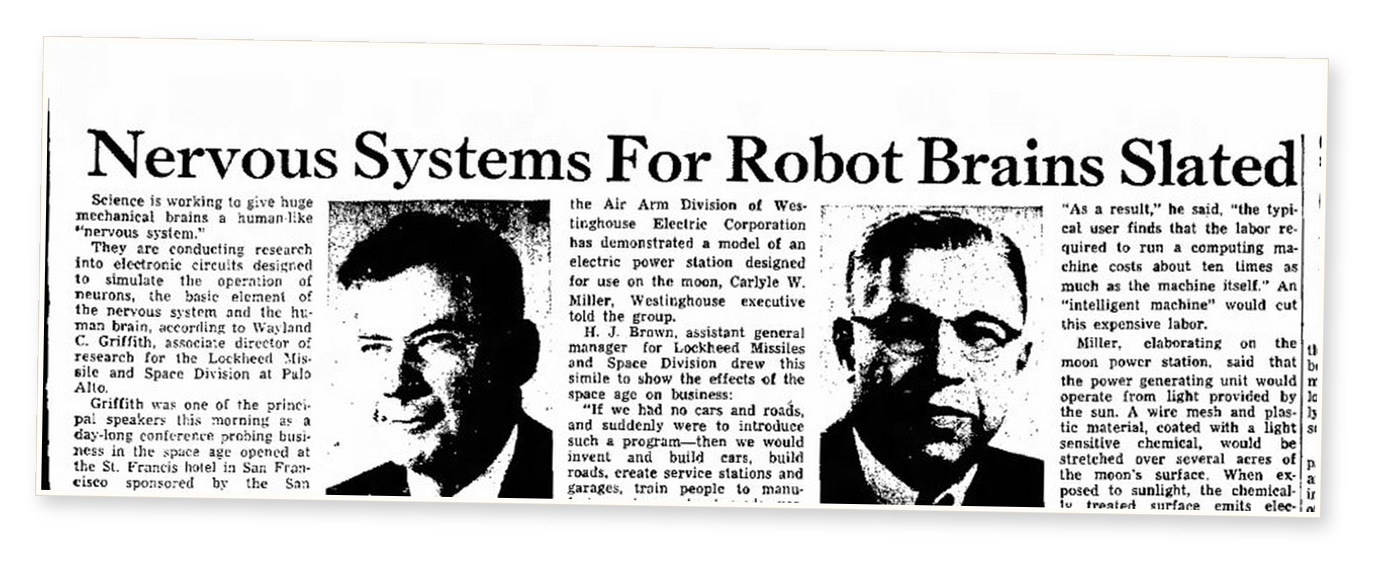
“Nervous Systems For Robot Brains Slated” from The Times (San Mateo) on March 11, 1959, reports on a day-long conference at the St. Francis Hotel in San Francisco where Wayland C. Griffith, associate director of research for Lockheed’s Missiles and Space Division at Palo Alto, described ongoing efforts to give machines a human-like “nervous system.”
Griffith told the audience that researchers were building electronic circuits designed to simulate the operation of neurons, the basic element of the nervous system and the human brain. He noted a key limitation of the era: a human can readily recognize a letter of the alphabet whether handwritten, printed, or typed, but machines could only recognize holes punched in a card. Current research, he said, gave great promise for the early development of automatic pattern recognition, which would open the way to automatic language translation. Machines would be built that could read books to the blind, translate foreign languages, and print words spoken into them.
Then comes the key line: Griffith reported that science was also working on a machine that would have some “artificial intelligence” to help it think, to some extent, for itself. Yet in the same address, he cautioned that machines have no intelligence of their own and must be given detailed instructions for every computational step.
This tension is what makes the article stand out. In a single talk, Griffith both introduced the aspiration of artificial intelligence and placed a firm boundary around it. The machine would “think, to some extent, for itself” — but only within the limits of what it had been explicitly told to do. In 1959, this was not a contradiction. It was an honest assessment of where things stood.