
When AI Was Imagined as a Model of the Learning Brain

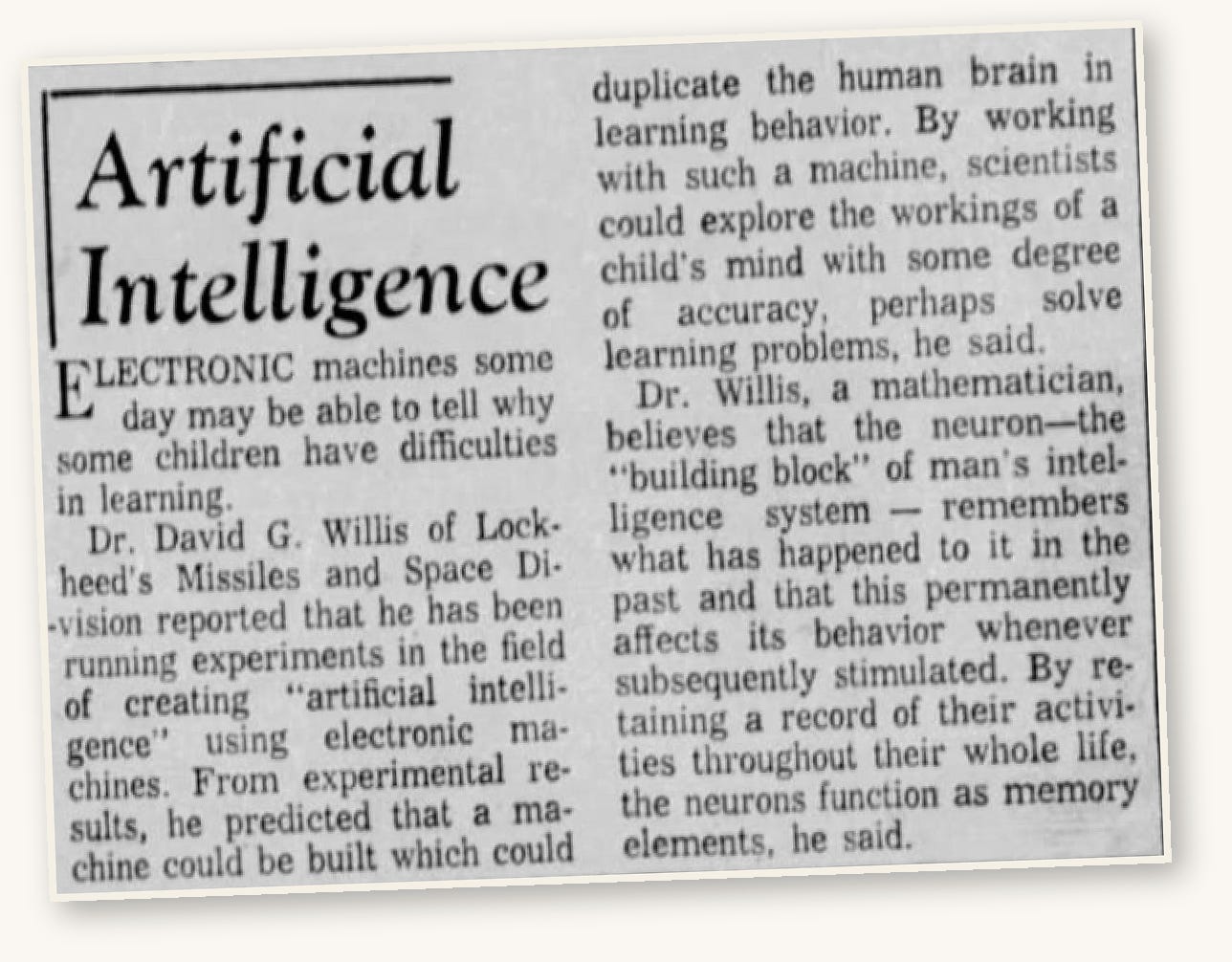
“Artificial Intelligence” from The Baltimore Sun on July 26, 1959, presents an early and unusual vision for AI — one focused not on computation or automation, but on understanding how the human brain learns.
The article reports on Dr. David G. Willis of Lockheed’s Missiles and Space Division, who had been running experiments in creating “artificial intelligence” using electronic machines. Willis proposed that such a machine could duplicate the brain’s learning behavior, allowing scientists to explore a child’s mind with greater accuracy and perhaps solve learning problems.
What is particularly notable is Willis’s understanding of the neuron as a memory element. He recognized that neurons retain a record of past activity throughout their entire life, and that this history permanently shapes their future behavior. This is a striking observation for 1959, and one that closely anticipates how modern artificial neural networks store and update learned information through weighted connections.
In 1959, just three years after the term “artificial intelligence” was coined at the Dartmouth Conference, here was a researcher from a missiles and space division framing AI not as a military tool, but as a means to model learning and memory at the level of the neuron.
Today, AI is used to personalize education and screen for learning difficulties, but Willis’s deeper vision of a machine that models how the brain itself learns and remembers remains largely unfulfilled. In 1959, it occupied a small column on page 17 of a Sunday paper, tucked between advertisements. The front page never noticed!