
🧠 When a Psychiatry Conference Accidentally Previewed the AI Revolution 📰

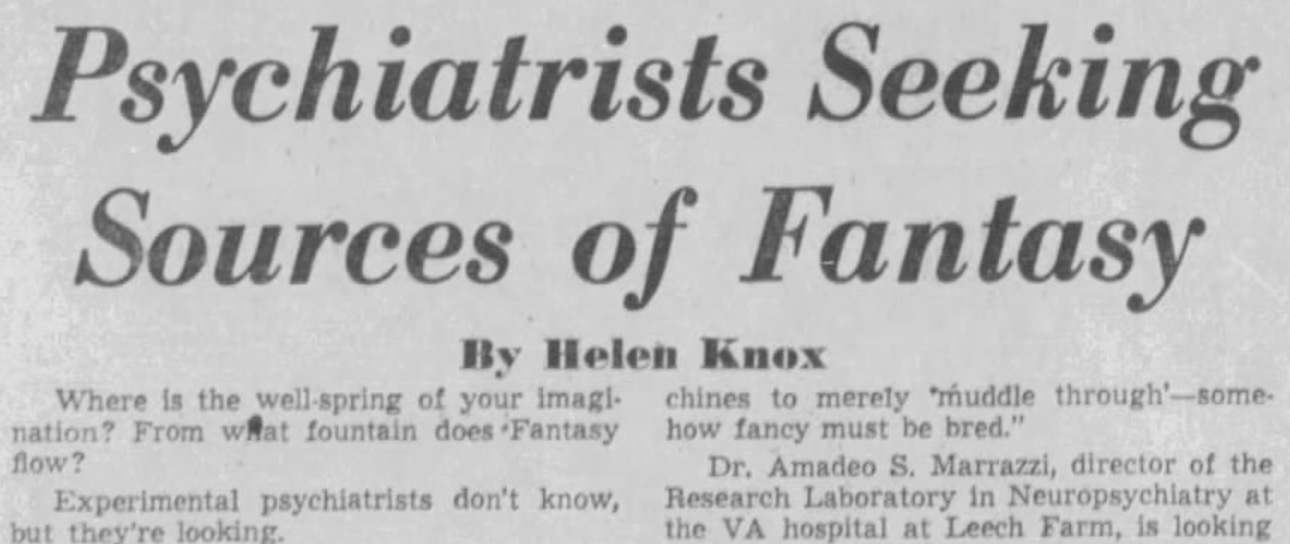
“Psychiatrists Seeking Sources of Fantasy” from the Pittsburgh Sun-Telegraph on March 6, 1959, captures a remarkable moment when artificial intelligence was discussed not at a computer science symposium, but at a psychiatry conference — and by none other than Warren S. McCulloch, one of the founding fathers of neural networks.
The article, written by Helen Knox, reports on the first day of the Bicentennial Conference on Experimental Psychiatry at the University of Pittsburgh, where over 400 doctors and scientists gathered. Their mission? To find the “well-spring” of human imagination, a quest the article describes as “far more intense than Ponce de Leon’s search for the fountain of youth.”
But it is McCulloch’s appearance that makes this piece a landmark in AI history. Described as a researcher from the Massachusetts Institute of Technology, McCulloch is reported to be “creating artificial intelligence with circuits”. This was 1959, just three years after the term “artificial intelligence” was coined at the Dartmouth Conference. Here was the co-author of the foundational 1943 paper on artificial neurons, standing before psychiatrists and declaring that machines would one day think creatively.
McCulloch’s quotes are striking in their ambition. He told the audience that if researchers could find “the womb of fantasy,” they could “destroy what causes the diseases of fantasy.” He spoke of Cybernetics (the study of the human brain through electronic brains) and made a prediction that still resonates: “We will someday be able to build machines with imagination — machines capable of creative thinking.”
McCulloch wasn’t speaking at an engineering lab or a computing workshop. He was addressing psychiatrists, positioning AI not as a tool for calculation but as a window into the human mind itself. The conference brought together researchers approaching the brain from radically different angles: McCulloch through electronic circuits, Dr. Amadeo S. Marrazzi through chemical imbalances, and Dr. Robert A. Patton through surgical experiments on monkeys that revealed the brain’s remarkable redundancy.
Patton’s findings — that a monkey could function “surprisingly well” after losing half its brain because of built-in duplication — led him to observe that “our brain duplications may be very important in meeting a stress situation.”
The 1959 framing of AI as deeply intertwined with psychiatry and neuroscience was ahead of its time! McCulloch understood something that took the broader AI community decades to fully appreciate: that understanding the mind and building intelligent machines are not separate endeavours, they are two sides of the same coin.