
The Slaves of Tomorrow
By Peter Moore — Lincolnshire Echo, December 12, 1958

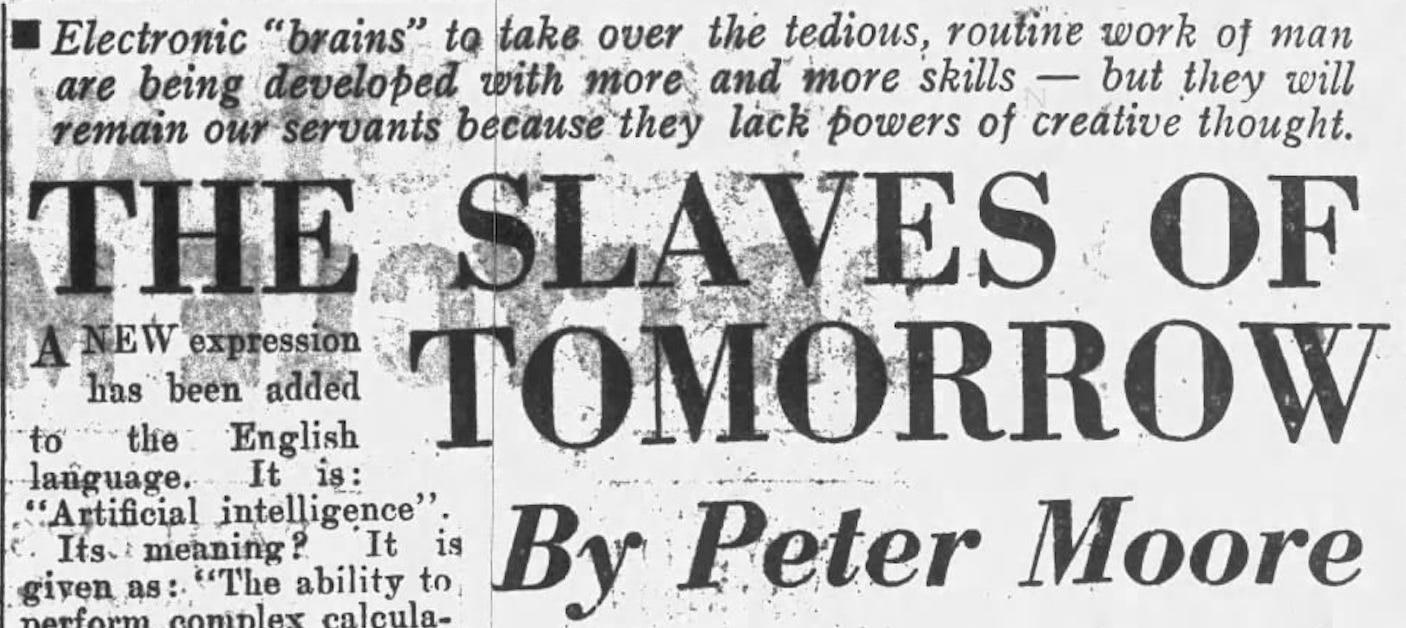
What did “Artificial Intelligence” mean in 1958? Peter Moore, writing in the Lincolnshire Echo, gives us a direct answer: “The ability to perform complex calculations, and yet to be so dull as to be incapable of the slightest spontaneity.” Capability without creativity. That was the definition on the table.
Moore puts a face to it. He introduces a friend he met — Emidec — whom he describes as “the most stupid creature I have ever come across.” Emidec can read and memorise the entire 24-volume Encyclopædia Britannica in less than four minutes, handle the output of 300 high-speed typists, and cope single-handed with the administrative work of a mail order business with 2,000,000 accounts. And yet he has no initiative, no spirit, no enterprise, no emotions and no ambition. He just does what he is told.
“He is fit to be no more than a modern beast of burden.”
Emidec’s full name is Emidec 2400, and is created by E.M.I. Electronics, Ltd. Moore is clear that nobody claims Emidec is the last word in abstract intelligence — but what strikes him is what that intelligence is actually for. Scientists, he writes, are producing these marvels in their struggle to relieve man of the tedious, routine work of everyday life, leaving him free for more worthwhile tasks. The machine absorbs the drudgery. The human mind goes elsewhere.
That idea gets a concrete illustration when Moore describes a symposium at Teddington on the “Mechanisation of Thought Processes.” A mechanical composer was given a musical note, instructed briefly in the principle of harmonic relationships, and told to get on with the job. It did pretty well — well enough that Dr. G. B. B. M. Sutherland, director of the National Physical Laboratories, remarked its music was “no more strange than some modern music.”
But the part of the article that stays with you is what Moore describes next. Work has already started, he writes, on a computer with a nervous system and a memory for faces — one whose intelligence will be modelled on the thinking mechanism of the octopus.
Professor J. Z. Young of University College London found that the octopus’s skill in recognising shapes depends on two sets of neurons that continually reactivate each other — one a memory store, the other a “printing” device that inscribes new impressions on the memory. Moore’s future friend will simulate both, with the help of 4,000 separate units, and will be “trained” to recognise shapes held in front of his “eye” and sounds made into his “ear.” Due to be completed by the end of 1960.
What Moore is describing is a machine that learns from experience and recognises patterns. The word “artificial intelligence” was in the article. The thing itself was already being built!
“Electronic ‘brains’ to take over the tedious, routine work of man are being developed with more and more skills — but they will remain our servants because they lack powers of creative thought.”