
The 1959 UNESCO Conference That Heard About "Artificial Intelligence"

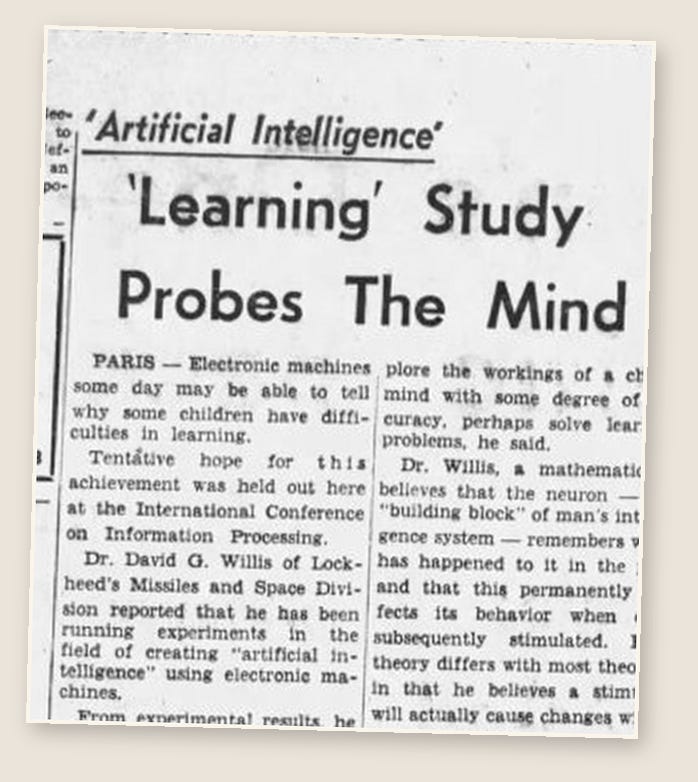
“Artificial Intelligence: ‘Learning’ Study Probes The Mind” from the Tallahassee Democrat on August 5, 1959, reports on Dr. David G. Willis presenting his work on artificial intelligence at the International Conference on Information Processing in Paris, a landmark UNESCO-organized event that would lead to the founding of IFIP the following year.
Willis, a mathematician at Lockheed’s Missiles and Space Division, reported that from experimental results he predicted a machine could be built which could duplicate the human brain in learning behavior. With such a machine, scientists could explore a child’s mind with some degree of accuracy and perhaps solve learning problems.
What is particularly notable is Willis’s understanding of the neuron as a memory element. He recognized that neurons retain a record of past activity throughout their entire life, and that this history permanently shapes their future behavior. His theory also departed from the mainstream: he believed that a stimulus would actually cause physical changes within the neuron itself, not merely pass through it. This was a bold position for 1959, and one that anticipates modern understanding of synaptic plasticity.
Willis presented these ideas on an international stage, at a time when the term "artificial intelligence" was barely three years old.