
Could Machines Be the Next Brain Boost?

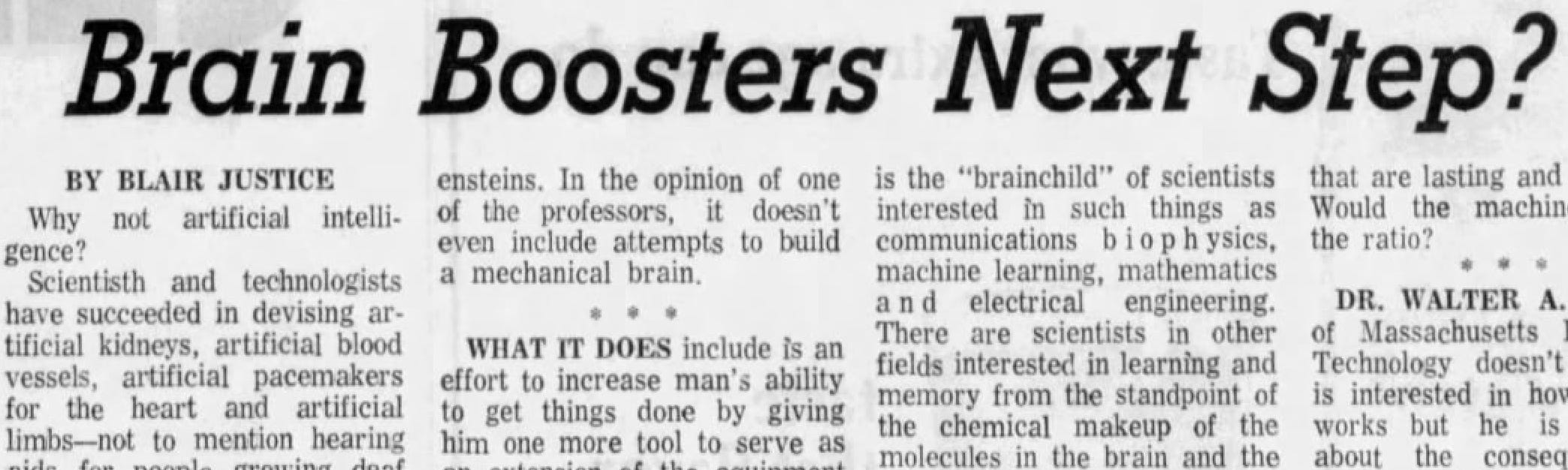
On November 20, 1963 (two days before President Kennedy’s assassination), the Fort Worth Star-Telegram ran a feature by Blair Justice titled “Brain Boosters Next Step?” The article asked: if we have built artificial kidneys, hearts, and limbs, why not artificial intelligence?
Justice reported on a gathering of professors near Boston who discussed what they defined as “the stimulation of human thinking by the use of machines to understand how the human brain works, so the machines can be taught to think better and faster than the brain itself.” AI wasn’t framed as a replacement for the mind, but as the next tool in humanity’s tradition of extending its own capabilities.
The language is striking. The article casually references “machine learning” alongside weather reports and Christmas ads in a Texas newspaper, decades before the term would dominate Silicon Valley. Dr. Samuel’s work teaching computers to play checkers was highlighted, a nod to Arthur Samuel of IBM, whose program is widely regarded as one of the earliest demonstrations of machine learning.
The article addressed the fear, too. Fiction writers had long imagined machines out-thinking their creators, but the researchers pushed back. Artificial intelligence, as discussed in 1963, “does not call for the construction of Frankensteins.”
Perhaps most telling: the article noted that only about one-tenth of one percent of the population “really do things” with their intelligence. If machines could help the rest of us think better, the gains would be enormous, an argument still fueling AI’s push into education and healthcare today.